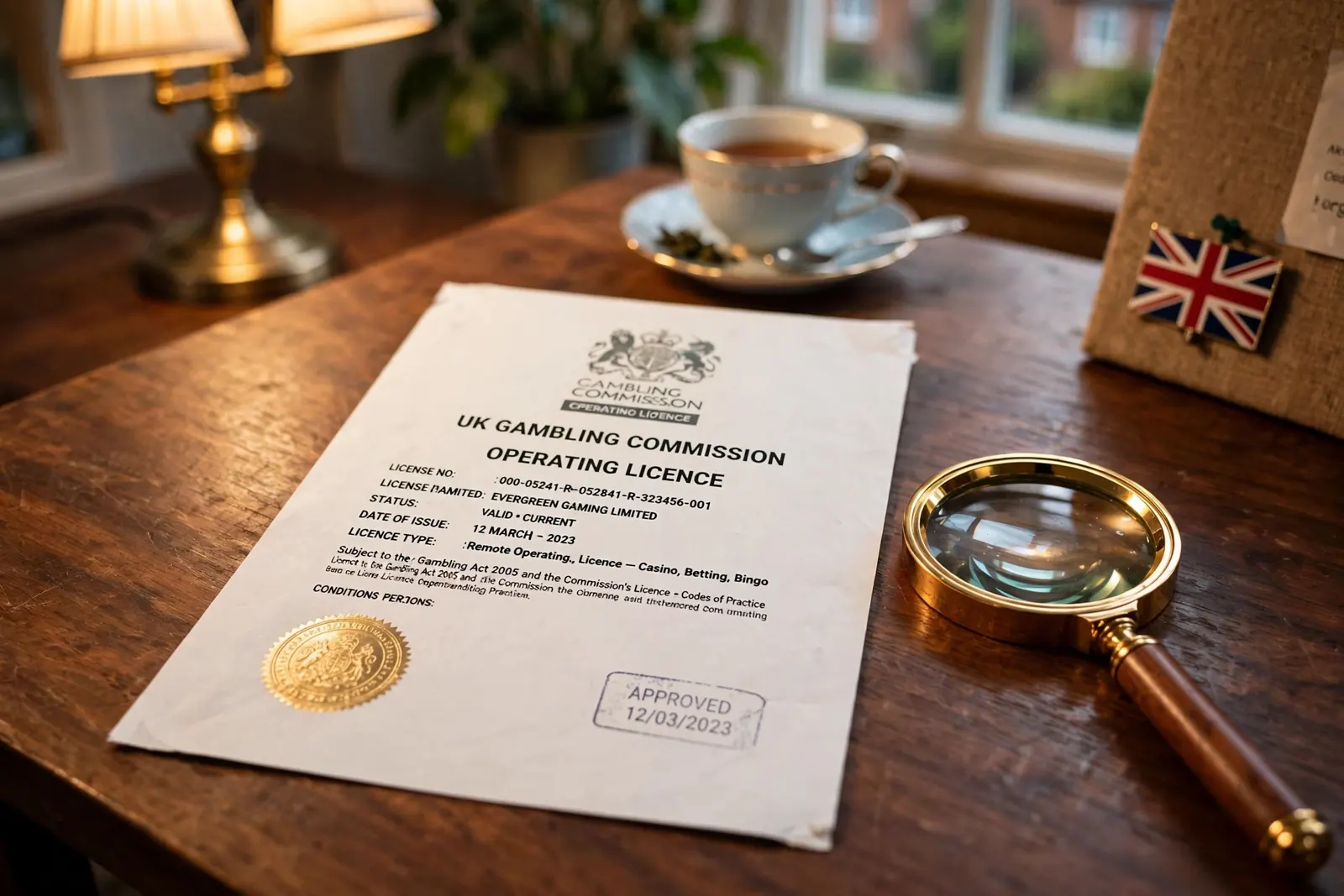
Safe online casinos in the UK: checks that matter
 Available in GB
A practical look at licensing, verification, bonus terms, payments and protections that can differ at offshore sites.

- What a UKGC Licence Actually Tells You
- The Checks I’d Make Before Trusting a Casino in 2026
- Best casino sites in the UK
- Offshore Casinos: Know Which Protections You’re Giving Up
- Real-Money Play Starts With Verification, Not Your First Withdrawal
- Bonus Maths: Read the Wagering Terms Before You Opt In
- “Best” Is Personal: The Checks I’d Use Instead of a Ranking
- Secure Payments: What Crypto and Bank Transfers Actually Mean
- Slot Rules in Britain: Slower Spins, No Autoplay
- Deposits, Cards and Payment Options: Check the Route, Not the Sales Pitch
- Casino Apps: Check the Operator Before You Install
What a UKGC Licence Actually Tells You
When I see a casino described as “safe”, I want to know what that word is resting on. For a site serving players in Great Britain, the starting point is whether its operator holds a UKGC licence. The UK Gambling Commission regulates gambling operators serving British players, and a casino must hold its licence to operate legally for them.
That is the legal baseline, not a gold star. A licence tells you the operator has the regulatory permission required to offer gambling to people in Great Britain. It does not, by itself, tell you that the site is enjoyable, that its terms suit you, or that you will never run into a problem. I used to treat a regulator’s name as shorthand for “nothing can go wrong”. That was too broad a conclusion.
What “licensed” means
The important thing is the operator behind the casino, not a reassuring badge in the page footer. A UKGC licence is a regulatory status: it distinguishes a casino legally authorised to serve players here from one that is not. In practical terms, if you are considering a UK casino, the presence of that licence is a threshold question, not a complete assessment of whether you should open an account.
That distinction is easy to miss because casino pages often place regulatory language beside promotional claims. “Trusted” and “secure” are persuasive words, but they do not change the legal requirement. Nor does a licence mean the Commission has personally recommended a particular casino to you. It means the operator is within the regulator’s licensing system.
I find it helps to separate two questions. First: is the casino legally entitled to serve players in Great Britain? Second: is it a good fit for me? The licence addresses the first. The second depends on what you value and how the site works for you. Blurring them is how a basic legal check turns into misplaced confidence.
The boundary matters
The Gambling Commission’s role is about operators serving British players. A casino does not become legally authorised for that market simply because it has a polished website, recognisable games or a claim about being regulated somewhere. For real-money online gambling in Great Britain, the relevant baseline is a current UKGC licence.
Non-UK-Licensed Casinos: What UK Players Should Know
There is a geographical wrinkle worth keeping straight. The Gambling Act 2005 governs gambling in England, Wales and Scotland, but not Northern Ireland. So when I say “Great Britain” in this context, I mean those three nations; it is not another way of saying the whole UK. The wording can look fussy, but legal boundaries are not improved by smoothing them over.
This is also why “UK casino” in a marketing headline is not enough to establish that an operator has the necessary status. A site can use language aimed at British customers without that phrase proving anything about its regulatory position. The legal question is about the operator’s permission to serve the market, rather than the impression created by its branding.
A licence is a starting point, not a promise
People searching for a safe online casino are often asking for more than a legal answer. They may want reassurance that their experience will be fair, straightforward and free of unpleasant surprises. A UKGC licence is relevant because it establishes that the operator is regulated for the British market. It cannot honestly be stretched into a promise that every individual experience will meet those hopes.
I learned to distrust neat labels after seeing how quickly “safe” can become a catch-all. It might refer to legal status, account security, the way a site handles money, or simply someone’s personal impression. Those are not interchangeable. The licence answers a clear question about legal authorisation; the word “safe” on its own often does not.
So, if you are comparing licensed online casinos in the UK, think of the UKGC licence as the floor beneath the decision. It is essential to the legal baseline, but it is not a ranking, a personal recommendation or a guarantee that you will like the operator. That is less comforting than a blanket promise. It is also more useful.
One other point: Casino not on Gamstop may receive a commission if you register with a partner casino through a link on this site. That commercial relationship should be visible to you, but it does not alter what a UKGC licence means. A legal requirement remains a legal requirement, whether a site is mentioned in editorial copy or through a commercial link.
Legal Baseline
A UKGC licence is a threshold requirement for legal operation in Great Britain, not a guarantee of personal suitability or a quality ranking.
The short version is simple: for a casino to operate legally for players in Great Britain, its operator needs a UKGC licence. That tells you where it stands in the regulatory framework. It does not make the rest of your judgement for you. A baseline, not a guarantee.
The Checks I’d Make Before Trusting a Casino in 2026
I used to treat a licence badge as if it settled the question. It doesn’t. A badge is just a claim on a webpage; the useful check is whether the operator behind that page appears in the UK Gambling Commission’s register, and whether the details match the casino you’re actually using.
I’d start with the licence information on the site and follow its link to the UK Gambling Commission’s public register. The regulator’s official registry should be linked beside the licence details. If the link is missing, broken or takes you somewhere that is not the Commission’s register, I’d open the register myself rather than accept a logo as proof.
Then I’d cross-check the licence number against the register. I’d also compare the exact website domain, the trading name shown to customers and the legal business named in the entry. These details can differ, but they should form a clear, consistent picture of who is operating the site. A familiar brand name on its own is not enough: a lookalike domain or a different company behind the page can change what you’re dealing with.
Merkur Casino Online UK: Rules and Reviews
If any part of that picture does not line up, I wouldn’t deposit while trying to talk myself into it. I’d contact the operator using details on its own site and ask for clarification, then check the register again. Don’t rely on a screenshot, a search-result snippet or a chat agent’s reassurance when the official record is available. Plain checks beat polished claims.
What the age checks should look like
A licensed platform must verify your age before letting you access gambling-related content, including free-play demos. It must also check your age before allowing you to deposit. That means a site that lets you browse games or play a demo without first confirming age is not following the required process for a UKGC-licensed platform.
I wouldn’t enter personal details just because a page asks for them, either. First make sure you’re on the domain that matches the regulator’s record. Then look for a clear explanation of how the operator handles the information it collects. An age check is part of the safety process, but it is not a reason to ignore whether the site itself is genuine.
I once assumed a demo was harmless because no money changed hands. That was the wrong way to think about it: the rule covers access to gambling-related content, not only paid play. If you can reach a demo before the platform checks your age, I’d stop and verify the operator rather than treating it as a harmless shortcut.
Do
- Cross-check the licence number against the official UKGC register
- Verify that the domain and business name match the register entry
- Confirm age before accessing any gambling content or demos
Don’t
- Rely on a licence badge or logo displayed on a webpage
- Accept a screenshot or chat agent’s word as proof of licensing
- Enter personal details before verifying the domain is genuine
Check the money safeguards, too
A UKGC-licensed operator must keep player funds separate from the money it uses to run the business. That separation matters, but it isn’t a promise that every player balance is protected in the same way if a company fails. I’d read the operator’s explanation of how customer funds are held and what level of protection it says applies. If the explanation is vague, don’t fill in the gaps with wishful thinking.
Before your first deposit, a new customer must be prompted to set a financial limit. The operator must also make account-level limit controls accessible, so you can review or change your limits without hunting through an obscure corner of the site. I’d take that prompt seriously and set a limit before funding the account. It is easier to decide what you can afford when you are not already caught up in a session.
A “safe” label can’t tell you whether a particular operator is right for you. I’d use it as a starting point, then check the register, domain, business identity, age process and account controls for myself. And if I register through a partner casino linked from this page, the site may receive a commission. That doesn’t change the checks I’d make. It does mean you should judge the operator on what you can verify, not on a recommendation alone.
Best casino sites in the UK
- x3betBonus: Welcome Pack 100% Up to £1.000 + 200 Free Spins · Payout speed: 1-3 business days
- BeOnBetBonus: 100% up to €500 + 100 FS · Payout speed: 1-3 business days
- NightWinBonus: £900 + 400 free spins · Payout speed: 1-3 business days
- DieselwinBonus: Welcome Pack 250% up to £4000 + 200 FS · Payout speed: 1-3 business days
- SpinFormulaBonus: 550% Up To £15,000 + 550 FS · Payout speed: 1-3 business days
- AmunbetBonus: Join now and get 450% up to 2,700 GBP + 450 FS · Payout speed: 1-3 business days
Offshore Casinos: Know Which Protections You’re Giving Up
An offshore casino can look polished, take your registration and accept your money. That does not make it a safe online casino in Great Britain. If an operator serves British players without a UKGC licence, it is outside the system that governs legal remote gambling here. A licence issued elsewhere does not give you the same protections as one from the UK Gambling Commission; the Malta Gaming Authority also has its own regulatory framework, but a foreign licence is not a substitute for the UKGC’s authority over operators serving this market.
Gibraltar Casino Licence in the UK: What It Means
I learned the hard way that a tidy homepage tells you very little. The key distinction is not whether a site displays a badge or calls itself “trusted”. It is whether the operator can be identified under a current UKGC licence. Without that, do not treat it as a licensed casino serving Great Britain, however familiar the games or payment logos may look.
What changes when a site is outside the UKGC system
The first practical difference is self-exclusion. UKGC-licensed operators must connect to GamStop, the scheme that lets a person exclude themselves from participating sites. An offshore operator is not obliged to connect to it. So if you have registered with GamStop, do not assume that exclusion will stop you opening an account or gambling on a site merely because the site accepts customers from Britain.
That gap matters most when you are trying to put distance between yourself and gambling. A site can make its own promises about account closure or limits, but those are not the same as being covered by GamStop. I would not rely on a familiar logo, a search result, or a line in a review to settle the question. Look for an identifiable UKGC licence entry before treating the operator as part of the British system.
There is also a difference if something goes wrong. Non-GamStop casinos operate outside UK dispute-resolution channels. That means you should not assume you can use the UKGC-regulated alternative dispute resolution route available in the licensed market. A complaints page on the casino’s own website may explain its process, but it does not by itself provide access to a UK-regulated independent route.
Offshore Risks
Operators without a UKGC licence operate outside the British system, meaning you lose access to GamStop self-exclusion and UK-regulated dispute resolution.
Player-fund protections need the same care. A UKGC-licensed operator must keep player funds separate from its operating money, but this is not a blanket guarantee that every balance is protected in the same way if a company fails. If you cannot identify a UKGC licence, do not assume UK-specific consumer-funds protections apply. Read the operator’s terms, but remember that wording on an offshore site cannot turn it into a UKGC-regulated business.
Don’t confuse access with protection
A non-GamStop site may be easy to reach from Britain. That says nothing about whether it is authorised to serve British players or what recourse you have if you dispute a balance, a withdrawal decision or the handling of your account. Offshore licences can involve different rules and oversight; they should not be presented as equivalent to UKGC regulation.
I also would not read “licensed” as a complete safety verdict, even when the licence is British. Licensing sets a regulatory framework; it does not promise that a particular casino will suit you or remove the need to make your own decisions. Still, the difference is concrete: licensed operators must take part in the relevant British safeguards, while an offshore site may sit beyond them.
When checking a safe online gambling site in Great Britain, I start with the operator’s identity and whether it appears in the UKGC register. If there is no identifiable entry, assume GamStop may not apply, UK-regulated dispute resolution may not be available, and UK-specific protections for customer funds may not cover you. That is a meaningful trade-off, not a technicality.
Casino Without a UK Licence: Rules and Risks
I used to take “internationally licensed” as reassurance. It wasn’t. A foreign licence may show that an authority has issued permission under its own rules, but it does not bring the UK’s safeguards with it. Before you deposit, decide whether you are willing to use a site that sits outside those protections. I wouldn’t blur that line.
Real-Money Play Starts With Verification, Not Your First Withdrawal
I used to treat identity checks as something to deal with later, when I wanted to cash out. That is backwards. A licensed operator must verify your identity before it can process a withdrawal, so leaving the paperwork until then can turn a win into a wait while you find documents and submit them.
I’d get the checks out of the way before depositing. After creating an account, submit government-issued photo ID and proof of address before adding funds. A passport or driving licence can serve as photo ID; a utility bill or bank statement can show your address, provided it is dated within the last three months. The operator may also ask you to confirm that the payment method belongs to you.
Keep the details consistent. The name and address on your documents should match the information you entered when registering. If something has changed, or you used a different name format, resolve that with the operator rather than hoping it will pass unnoticed. I learned that “I’ll sort it when I need the money” is not a plan. It is a delay you can create for yourself.
Identity Verification
Step 1: Submit Photo ID
Provide a government-issued photo ID, such as a valid passport or driving licence.
Step 2: Provide Proof of Address
Upload a bank statement or utility bill dated within the last three months.
Step 3: Match Details
Ensure the name and address on your documents are consistent with your registration info.
Step 4: Confirm Payment
Verify that the payment method used for deposits belongs to you.
There are two checks people often blur together. On licensed platforms, age must be verified before you can access gambling-related content, including free demos, and before you can deposit funds. Identity verification for a withdrawal is a separate point in the account journey: it must be completed before the operator processes your payout. A site asking for documents is not, by itself, proof that the whole process is safe; it is one part of account verification.
When you upload documents, use the operator’s account area or the submission route it identifies. Check what each image needs to show, and make sure the details are legible. If a document is rejected, read the reason and correct that specific issue rather than repeatedly sending the same file. Keep copies of what you submitted and any messages about the check, so you can follow up clearly if the account remains pending.
This is a practical step whether you are playing slots for real money or trying a casino game with a welcome offer. A “safe” label does not make a withdrawal instant, and verification does not guarantee that every site will suit you. It does mean you can avoid adding a preventable paperwork snag to the process. For me, that is a more useful test than a polished promise on a landing page.
If you register through a partner casino link on this site, Casino not on Gamstop may receive a commission. That does not change the documents you should prepare or the need to complete checks before depositing. Be ready to verify who you are first. Much less hassle.
Online Casino No Registration UK: What It Means
Bonus Maths: Read the Wagering Terms Before You Opt In
I used to see a bonus figure and treat it as money I could play with straight away. The part I missed was the wagering requirement: the amount of eligible betting you must complete before bonus-related winnings can be withdrawn. The key detail is what the multiplier applies to. It may be the bonus alone, or the deposit and bonus added together.
A specialist review uses this comparison: deposit £100 and receive a £100 bonus, with a 35x wagering requirement. If the multiplier applies to the bonus only, the turnover is £3,500. If it applies to the combined £200, the turnover is £7,000. Same offer on the banner. A very different amount to play through.
That 35x example shows the effect of the wording; it is not a permitted current incentive requirement. Wagering requirements attached to incentives must not exceed 10x. Check the full terms before opting in, and make sure you can tell which amount the requirement applies to. If the wording leaves that unclear, I’d leave the offer alone.
Also check which games count. A single incentive must not bundle different types of gambling product, such as casino play and betting, into one offer. The terms should tell you which play contributes towards completion. A specialist review reports that slots may count in full while table games count at a smaller share, so don’t assume every stake advances the requirement equally; look for the game-specific contribution rules.
Wagering Limits
Under current rules, wagering requirements attached to incentives must not exceed 10x.
The maximum eligible bet matters too. A specialist review reports that operators often set a £5-per-spin cap while bonus credit is active. Read that limit before playing: exceeding the permitted stake can put the bonus or related winnings at risk under the offer terms. Don’t rely on memory or a banner summary; check the conditions attached to the specific promotion.
I now read the offer from the wagering clause backwards: what counts, what is excluded, and what stake cap applies? Then I decide whether the bonus is worth the conditions. “Free” can be costly in time and play.
A safe choice is not simply a casino with a large headline offer. I’d judge the promotion by its written conditions and whether I’m comfortable with the required turnover. If you register through a partner casino link on this site, Casino not on Gamstop may receive a commission. That does not change the need to read the terms for yourself.
“Best” Is Personal: The Checks I’d Use Instead of a Ranking
I used to treat “best” as if it meant one casino everyone should choose. It doesn’t. A site that suits someone who wants a large game library may be a poor fit for someone who wants firm spending controls and no bonus prompts. I’d rather decide what matters before opening an account than trust a tidy ranking.
For me, the first practical test is whether the account tools are easy to find and use. UKGC-licensed operators have to let customers set deposit limits, take a time-out or self-exclude through GamStop. I’d look for those controls in the account area, not just in a footer link. If setting a limit feels confusing before you have deposited, that tells you something about the experience you’re signing up for.
There is another step before that first deposit: the operator has to prompt new customers to set a financial limit. Once you’re playing, the limit controls should remain accessible at account level. I wouldn’t treat these as decorative responsible-gambling links. They’re useful only if you can find them when you need them and make a choice without hunting through the site.
Affordability checks are worth understanding too. UKGC-licensed platforms can ask some customers for income verification when spending meets criteria linked to thresholds that are not published in advance. That can feel intrusive if you weren’t expecting it. I’d factor in that possibility rather than assume every request means something has gone wrong.
This is why “safe” and “best” aren’t quite the same question. A legitimate online casino may still have terms, prompts or account features that don’t suit you. And if you’re looking at bonuses, keep the wagering requirement in view; the headline offer isn’t the whole cost. I’ve made that mistake before. The small print matters.
My own shortlist would start with the controls I’d actually use: deposit limits, time-outs and self-exclusion. Then I’d consider whether the site’s general setup feels manageable for me, rather than chasing a badge or a promise of “the best experience.” No ranking can know your budget, habits or tolerance for promotional nudges.
If you register through a partner casino link on this site, we may receive a commission. That doesn’t make a recommendation right for you, so make the call on the operator and its tools, not on a label. A good fit is personal. My test is simple: can I stay in control without having to fight the interface?
Secure Payments: What Crypto and Bank Transfers Actually Mean
When I compare withdrawal routes, I separate the operator’s processing time from the time the money takes to reach me. They are not the same clock. A crypto estimate that starts after processing tells you nothing about how long the request may sit with the casino first.
Understanding Payout Timings
Withdrawal time consists of two stages: the operator’s processing time and the network settlement time. For example, crypto may settle on-chain in 10–30 minutes, but only after the casino has processed the request. Bank transfers typically take 3–5 banking days.
A specialist review comparing casino payment timings reported that crypto withdrawals settled on-chain within 10–30 minutes after the operator had processed them. That is the network-settlement window, not a promise that funds will arrive within that time of clicking “withdraw”. If the casino has not completed its processing, the on-chain clock has not started. Small distinction. Big difference.
The same specialist review comparison reported bank-transfer withdrawals taking 3–5 banking days across the brands it covered. Treat that as a reported comparison, not a guaranteed timetable for every casino or transfer. A banking-day estimate also isn’t the same as a count of ordinary calendar days.
So which route makes a secure casino payment? The timing alone cannot answer that. A quick settlement does not prove that an operator is trustworthy, and a slower transfer does not by itself mean something is wrong. I used to read a short payout estimate as a reason to relax. It only described one stage of the journey.
With crypto, keep your expectations tied to the stated on-chain period after processing. With a bank transfer, allow for the longer reported window and avoid making plans around an exact arrival date. Before requesting either, read the casino’s own withdrawal terms so you know which method it supports and what timing it actually gives you. Don’t assume a payment route shown on a general casino page is available for every account.
If you are considering a safe crypto casino in the UK, focus on the operator and its terms, not the word “secure” beside a coin logo. I would not treat a payment method as a substitute for checking where I am playing. That’s the bit I learned the hard way.
Casino not on Gamstop may receive a commission if you register with a partner casino through this page. That does not change the distinction between the reported settlement timing and the operator’s processing stage.
Slot Rules in Britain: Slower Spins, No Autoplay
When I first noticed that a slot would not keep spinning by itself, I assumed I had missed a setting. I hadn’t. Autoplay is banned on online slots in Britain, so you have to start each spin yourself. UKGC-licensed slot games had autoplay removed in 2021.
That changes the rhythm. There is no button to queue spins while you look away or check something else; each one needs your attention. It does not make a game safe by itself, or stop you spending more than you intended. It simply removes one way of letting spins run unattended.
There is also a minimum interval: each online slot spin must last at least 2.5 seconds. The rule was introduced to slow play and reduce the intensity of a session. A quick game can still feel absorbing, but the pace cannot be accelerated past that floor.
I find it helps to separate these rules from marketing claims about “safe” games. The mechanics are regulated; the outcome of a spin is still uncertain. A calmer pace is not a promise that you will win, and it does not replace deciding when to stop.
Attention If an online slot offers autoplay or spins faster than the 2.5-second minimum interval, it is not adhering to UKGC rules for the British market.
If a slot offered to spin automatically on a site serving Great Britain, I would treat that as a reason to pause and check what I was playing, rather than as a handy extra. The same goes for a game that appears to move faster than the required interval. These are basic rules for online slots here, not optional features a casino can switch off.
So when you choose a slot, focus on what the game actually does and whether you are comfortable with its pace. “Easy play” can just mean fewer moments to notice how long you have been going. Take the spin yourself. Keep your eyes on it.
Deposits, Cards and Payment Options: Check the Route, Not the Sales Pitch
I used to read a cashier page as if every logo meant “available to me”. It doesn’t. A payment option can depend on the operator, your account and the route the money takes, so check the terms shown at the casino before you try to deposit.
For gambling in Great Britain, remote operators cannot accept credit-card payments. That includes a credit card used through a money service business to fund gambling. Nor can an operator accept a wallet payment if that wallet lets credit-card funds be used for gambling. The route matters, not just the name on the payment button.
That distinction is easy to miss. A wallet may look separate from a card, but if credit is behind the funds, it is not a way around the restriction. If a cashier offers a method you do not understand, pause and check how it is funded and whether the operator permits it for gambling. No guesswork.
PayPal is not a dependable feature of non GamStop casinos: a specialist review reports that its availability is not universal and depends on PayPal approving the merchant. Seeing PayPal mentioned in an advert, therefore, does not mean it will appear in the cashier or work for your account. Check the actual payment page rather than treating a promotional claim as confirmation.
Before your first deposit, the operator must prompt you to set a financial limit, and account-level limit controls must remain accessible. I’d set a limit I can live with before money is in play; changing course after a deposit is the sort of decision I used to make too late.
A payment method is only one part of a safe deposit choice. Check the route, the conditions and the limit controls before sending funds. If this page links to a partner casino and you register, Casino not on Gamstop may receive a commission. That does not change the payment rules, but it is worth knowing.
Casino Apps: Check the Operator Before You Install
An app-store listing can look polished and still leave you unsure who is behind it. I don’t treat a familiar logo or a “licensed” badge as proof: a lookalike app can borrow the language and design of a real casino. The important question is whether the app points to the same operator that appears on the UK Gambling Commission’s register.
Before installing, find the operator’s licence details in the app listing or on its linked website. Then open the UK Gambling Commission’s public register yourself. Check that the registered business and trading name match, and compare the exact website domain associated with the operator. A working link to the register should sit alongside licence information; if the app offers only a badge or a vague claim, that is not enough for me.
I also check who published the app and whether its links lead to the operator’s own site, rather than a different domain with a similar name. If those details don’t line up, I stop there. No install.
A licensed app should not let you reach gambling-related content, including free demos, before your age has been verified. If it appears to offer that access without a check, don’t assume the app is legitimate just because it is available to download.
If you choose to register through a partner link on this site, Casino not on Gamstop may receive a commission. That does not change the checks I’d make: verify the operator behind the app, not just the icon on your screen.
Is it safe to play at online casinos in the UK?
A UKGC-licensed casino is legally authorised to serve players in Great Britain, and its licence can be checked against the Commission’s register. Licensed operators must provide deposit limits, time-outs and GamStop self-exclusion, but a licence is not a guarantee that every experience will be problem-free.
What determines how an online casino bonus works in practice?
Check whether wagering applies to the bonus alone or to your deposit and bonus combined, and how much different games contribute. For example, slots contribute 100% of each pound staked, while table games typically contribute 5% to 10%; eligible bets may also be capped at £5 per spin while bonus credit is active.
What are the differences between UK-licensed and non-UK-regulated online casinos?
UKGC-licensed operators must provide deposit limits, time-outs and GamStop self-exclusion, segregate player funds from operating capital, and follow the UK credit-card deposit ban. Offshore-licensed casinos are not required to connect to GamStop, sit outside UK dispute resolution channels, and may still accept credit cards.
Created by the "Casino not on Gamstop" editorial team.