British Casinos Not on GamStop: Licensing Explained
 Available in GB
GamStop restricts access to UKGC-licensed gambling establishments, while sites outside that jurisdiction sit beyond its reach.
- What “Not on GamStop” Actually Means
- Best casino sites in the UK
- Online Casinos, UK Players and the Licensing Line
- How to Check a Site’s Licence Without Guesswork
- What Protection You May Be Giving Up
- If You’re Self-Excluded, Don’t Look for a Workaround
- Bonus Maths: Wagering and Game Weighting
- Free Spins: Read the Small Print First
- Self-Exclusion Periods and Tools on Overseas Sites
- Withdrawals, Verification and Crypto Risks
- No-Deposit Bonuses: Check What You’d Have to Do
What “Not on GamStop” Actually Means
“Not on GamStop” describes a boundary, not a type of game or a special feature. GamStop is a self-exclusion service: when someone registers, it restricts their access to gambling at establishments licensed by the UK Gambling Commission (UKGC). The key point is that the restriction applies within the Commission’s jurisdiction. It does not automatically reach every gambling business a person might encounter.
I used to read the phrase as if it meant a casino had somehow switched GamStop off. That is too loose. The useful question is not whether a site uses the label, but whether the gambling establishment falls under the UKGC’s authority. If it does, registered users are restricted there through GamStop. If it operates outside that jurisdiction, GamStop’s restriction does not apply to it.
That distinction matters because the words “British casino” can sound broader than the regulatory boundary they describe. A site may be presented to British players, use familiar language or accept customers from the UK, but those details do not, by themselves, tell you whether GamStop covers it. The phrase “not on GamStop” is about the relationship between an establishment and the service; it is not proof of what kind of casino it is, where it is based, or what protections it offers.
USA Casinos for UK Players: Licensing and Risks
What the restriction covers
For a registered user, GamStop’s role is to restrict gambling at establishments licensed by the UK Gambling Commission. Think of it as a defined perimeter rather than a universal block on gambling. Its reach follows the UKGC’s jurisdiction. That is the cleanest way to understand why the same self-exclusion registration may apply at one gambling establishment and not another.
This is also why “British online casinos” and “casinos not on GamStop” are not opposite descriptions in a simple, reliable way. “British” can be used casually to mean a site aimed at people in Britain, while GamStop’s coverage depends on UKGC jurisdiction. A site’s branding or intended audience does not establish that boundary. The label alone tells you very little beyond the claim that GamStop does not apply there.
I find it helps to separate three ideas that often get muddled together: the player, the self-exclusion service and the establishment. A person registers with GamStop; the service restricts that person at establishments within the UKGC’s reach. The service is not a universal lock on the person’s ability to find or access every gambling service. Nor does the phrase “not on GamStop” explain why a particular establishment sits beyond that boundary.
What the phrase does not tell you
The label is easy to mistake for a recommendation. It is not one. “Not on GamStop” does not mean a site is suitable for someone who has self-excluded, and it does not mean that GamStop has approved or assessed the site. It only points to the fact that the service’s restriction does not cover that establishment in the same way it covers UKGC-licensed gambling establishments.
Trusted Casinos Not on GamStop UK: Key Risks
That distinction can feel technical, but it has a practical consequence: seeing a casino described as “not on GamStop” should not be treated as a loophole built into the service. It means the service has a jurisdictional limit. The phrase does not change the purpose of self-exclusion, and it does not make gambling outside that boundary a sensible next step for someone who registered to stop.
I have learned not to let a short label do the thinking for me. It compresses a regulatory boundary into a few words, then leaves the reader to fill in the gaps. “Not on GamStop” is not the same as “safe”, “approved” or “right for you”. It is a narrow description of coverage.
So, when you see the term in a discussion of British casinos online, read it literally: GamStop restricts registered users at gambling establishments licensed by the UKGC, and its reach is limited to the Commission’s jurisdiction. That explains what the label means—and just as importantly, what it does not establish. A label is not a verdict.
Best casino sites in the UK
- x3betBonus: Welcome Pack 100% Up to £1.000 + 200 Free Spins · Payout speed: 1-3 business days
- BeOnBetBonus: 100% up to €500 + 100 FS · Payout speed: 1-3 business days
- NightWinBonus: £900 + 400 free spins · Payout speed: 1-3 business days
- DieselwinBonus: Welcome Pack 250% up to £4000 + 200 FS · Payout speed: 1-3 business days
- SpinFormulaBonus: 550% Up To £15,000 + 550 FS · Payout speed: 1-3 business days
- AmunbetBonus: Join now and get 450% up to 2,700 GBP + 450 FS · Payout speed: 1-3 business days
Online Casinos, UK Players and the Licensing Line
The phrase “British online casino” sounds straightforward, but it can describe two different things: a casino licensed to serve customers in Great Britain, or a site that a British player can reach from home. Those are not the same. I learned to stop treating a site’s availability as proof that it is authorised to operate here. A page loading on your phone tells you very little about the operator’s legal position.
Illegal Operation
If an operator offers its services to UK residents without the required UKGC licence, the operator is acting illegally.
For real-money online gambling offered to customers in Great Britain, the operator needs a licence from the UK Gambling Commission (UKGC). That requirement applies whether the company is based here or somewhere else. So a site may be based overseas, and still need UKGC authorisation if it is offering gambling services to people in this market. A foreign address does not make the requirement disappear.
That is the line people often miss when they search for a British casino online. They see a site accepting a UK registration, displaying games and taking payments, then assume it must be operating legally in Britain. But being reachable, or even being willing to accept a customer, is not the same as holding permission to serve the British market. If an operator offers its services to UK residents without the required UKGC licence, the operator is acting illegally.
There is a separate point about the player. Playing at a casino that is not on GamStop is not, by itself, a criminal offence for the customer. That does not turn the operator’s conduct into a lawful one, and it does not give the site the status of a UK-regulated casino. The distinction matters: one question is what the player may face; another is whether the business is authorised to provide online gambling here.
I used to blur those questions together. If a site looked polished and let me through, I treated that as a quiet sign-off. It wasn’t. A clean homepage, familiar payment wording or a British-sounding name cannot replace a UKGC licence. “UK-friendly” is a marketing phrase, not a regulatory category.
Non-GamStop European Casinos: What the Label Means
You may also find casinos licensed in another jurisdiction. That tells you something about the operator’s relationship with that regulator, but it does not establish that the operator is licensed to serve customers in Great Britain. An overseas licence and a UKGC licence are not interchangeable. Nor does a site become a British online casino simply because British players can open an account there.
This is why lists of “top British online casinos” can be slippery. The heading might imply a set of locally licensed operators, while the sites below it could include businesses that are merely accessible from the UK. “Best” is not a legal status either. Before taking a ranking at face value, separate the writer’s label from the question that actually matters: is this operator authorised to offer gambling to customers in this market? I would not use a list’s position as an answer.
The same applies when a site calls itself one of the new British online casinos. “New” may describe when its website appeared, but it says nothing about whether it has permission to operate here. A fresh design and a launch offer can make a site feel established before you have checked what stands behind it. That impression is easy to mistake for reassurance.
There is also a difference between choosing to visit an overseas site and the operator actively offering services to people in Britain. The first describes a player’s action; the second describes the business and its obligations. People often compress both into “Can I play there?” That question is too broad to be useful on its own. The operator’s authorisation and the player’s legal exposure are separate issues, even when they concern the same account.
International Casinos for UK Players: UKGC Risks
So when you see “UK online casino sites” used as a category, don’t assume it means every listed casino holds UKGC permission. Some wording is loose; the licensing requirement is not. A site outside the UKGC framework does not provide the consumer protections associated with a UKGC licence. That is not a claim that every foreign operator behaves identically. It is a reminder that access to a site does not put it under the British regulator’s rules.
I now read “available to UK players” literally: it says the site may be reachable or may accept registrations, not that it is authorised to serve the market. The regulatory question is about the operator’s licence, not the player’s postcode alone, and not the casino’s branding. Keep those pieces separate. It saves a lot of wishful thinking.
How to Check a Site’s Licence Without Guesswork
A licence badge in a footer is a claim, not proof. I’d treat it like any other detail a gambling site gives you: check who issued it, find the operator in that regulator’s own records, and make sure the details line up. A polished logo can be copied. A record in an official register is harder to fake.
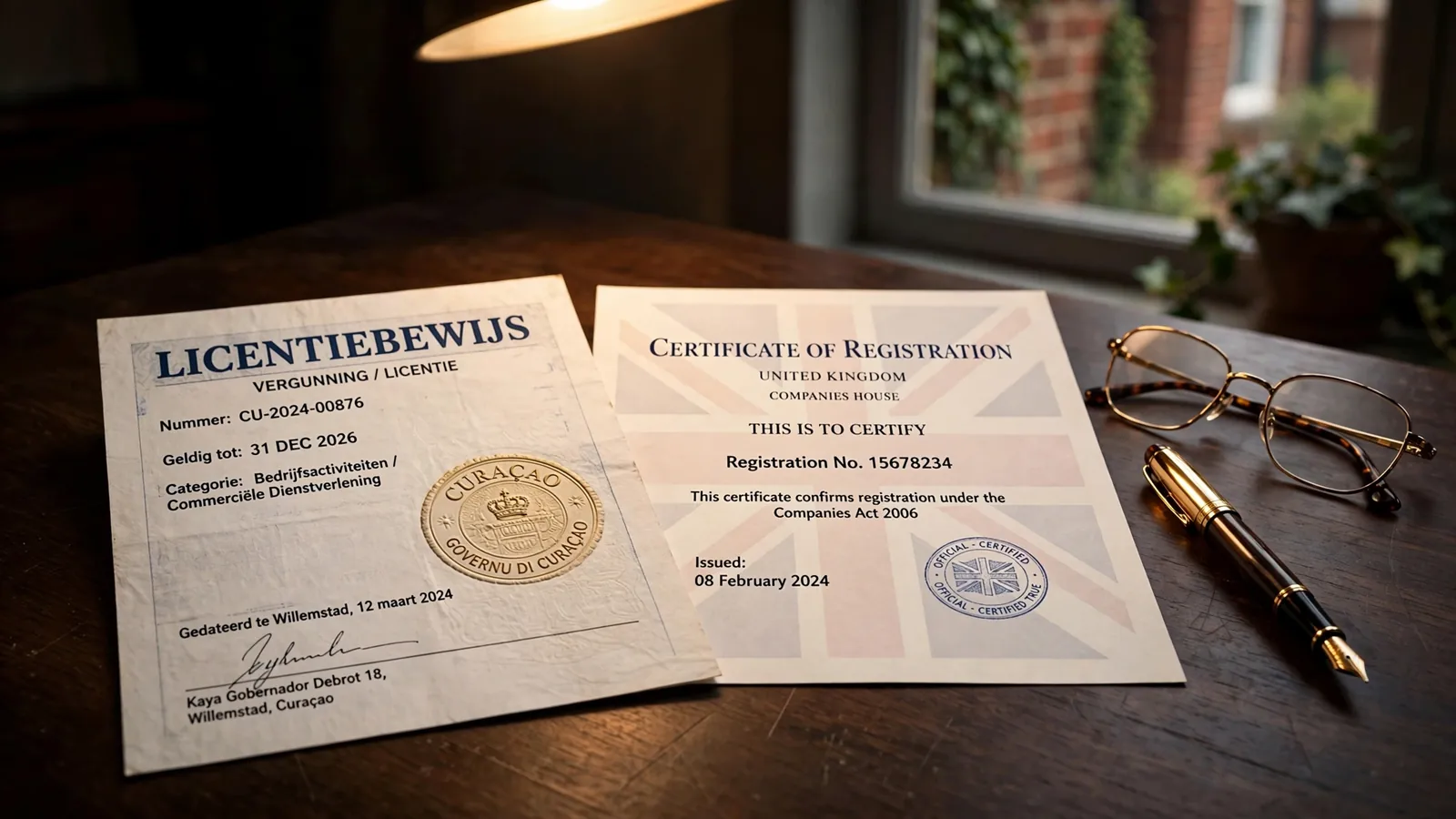
Some casinos based outside the UK may hold licences from Malta, Gibraltar or Curacao. That tells you which authority claims oversight of the operator; it does not mean the casino holds a UK Gambling Commission licence. Nor does a foreign licence make a site authorised to offer real-money gambling to people in Great Britain. The distinction matters, even when a site looks like one of the British casino sites you already know.
Start with the operator, not the badge
Look for the legal company name in the site’s terms or licensing page. It may differ from the brand shown across the top of the page. Note the licence number and the regulator named there, then search the regulator’s official register yourself. Don’t rely on a search result snippet, a review page, or a link that the casino supplies as its only evidence.
Compare the register entry with the site’s claims. Does the company name match? Is the licence shown as current? Does the record identify the same brand or website address? If the public record does not let you confirm a particular detail, treat that as unresolved rather than filling the gap with a confident-looking badge.
For a Malta claim, check the Malta Gaming Authority’s own records; for a Curacao claim, use the relevant official regulatory records rather than accepting a logo at face value. Apply the same principle to a Gibraltar claim: find the regulator’s own information and check the entity against it. A licence number that cannot be traced, a different company name, or a domain that does not match the listing are reasons to stop and investigate—not minor bits of paperwork.
Check what the licence actually covers
A register entry is useful only if it relates to the operator you are dealing with. A company might appear in a regulator’s records, while the brand or domain you have open is not clearly connected to it. Read the terms for the operating company and compare that wording with the register. If the site’s account page, footer and terms name different businesses without explaining their relationship, don’t assume they are interchangeable.
Verify a Licence
Identify the operator
Find the legal company name in the site’s terms or licensing page, noting the licence number and regulator.
Search official records
Search the regulator’s official register yourself instead of relying on a link provided by the casino.
Compare the details
Confirm that the company name, licence status, and brand or website address in the record match the site’s claims.
Also check the authority itself. The UK Gambling Commission’s requirements apply to operators serving the British market. A licence from a less established gambling regulator may offer less protection than a UKGC licence; a regulator’s name on a page does not make the standards equivalent. I wouldn’t call a site “safe” just because I found a foreign licence entry. That word does too much work.
This is where “licensed” can become a slippery advertising word. It may mean the operator has a licence somewhere, not that it is licensed for British customers or subject to UKGC rules. Casinos operating under foreign licences are not required to connect to GamStop. The foreign regulator’s register can help you verify a claim, but it cannot turn that licence into a UK one.
Keep the checks separate
A licence search answers a narrow question: can you verify that this operator is listed by the authority it names, and do the relevant details match? It does not settle whether the casino is authorised to serve you in Britain. For that, the relevant question is whether it holds the required UKGC licence. A foreign entry is not a substitute.
Nor is a page calling itself one of the best UK casino sites evidence of licensing. The same goes for claims about British casino bonuses, British slots or a “top” ranking. Those are promotional descriptions; they tell you nothing reliable about the regulator’s records. I’ve learned not to let a tidy comparison table do the checking for me.
If you can’t confirm the operator and its claimed licence through official records, don’t treat the claim as verified. If the details conflict, or the site avoids naming the legal company behind it, leave the uncertainty where it belongs: with the site, not with your assumptions. No badge fixes that.
What Protection You May Be Giving Up
A licence is not just a badge in a footer. It tells you which regulator sets the operator’s rules and where those rules apply. A casino licensed outside the UK may be overseen by its own regulator, but it remains outside the UK Gambling Commission’s framework. That difference matters when you need more than a games page and a payment button.
With UKGC-licensed casinos, participation in GamStop is required. Casinos not on GamStop do not have that same obligation, and a foreign licence does not make them part of the UK system. Nor does it make their protections equivalent to those available at a UK-licensed operator. I used to treat a licence logo as if it answered every question. It doesn’t. It points you towards the rules that may apply; it does not tell you that UK safeguards are in place.
Responsible-gambling controls are a practical example. A specialist review has reported that some non-UK sites provide tools such as deposit or loss limits, session time limits, reality checks and self-exclusion. Their presence is voluntary where the operator’s regulator does not require them; it should not be assumed just because the site has a licence. Even when a tool is available, you need to see how it works: whether you can find it in your account, what it covers and whether the operator explains its effect clearly.
That is a different question from whether the licence itself is genuine. A verified licence can establish that an operator is answerable to a particular regulator. It cannot, on its own, establish that every safeguard you would expect from a British online casino is available to you. Regulators also differ in how demanding their standards and complaint processes are. A licence from a less established authority may offer less protection than UKGC licensing, so “licensed” is not a complete safety verdict.
Support is another gap to consider. If a dispute arises, the operator’s regulator and support channels may be outside the UK, and you may not have access to UK-based player support services. That can make it harder to know who can help or what route is available if the casino does not resolve a problem. Before depositing, I would want to know how to contact the operator, how complaints are handled and which regulator is responsible. If those answers are difficult to find, that is information too.
The same caution applies whether you are browsing on a phone, looking at live tables or searching for a real-money casino that accepts British pounds. A polished mobile site, live chat or familiar currency does not put an operator under UKGC rules. Nor does a claim that a site is among the “best UK casinos” change its regulatory status. Marketing language is easy. Enforceable protections are the point.
Some overseas operators may offer limits, reminders or a way to exclude yourself, but those features are not automatically a substitute for the UK framework. Check what the operator actually provides, and do not confuse a voluntary feature with a protection backed by UKGC requirements. If you are relying on a tool to control gambling, uncertainty about whether it exists or how it is enforced is not a small detail.
The short version: the licence tells you who regulates the operator. It does not promise UK-level safeguards, UK-based support or access to GamStop. That distinction is easy to miss. It matters.
If You’re Self-Excluded, Don’t Look for a Workaround
When I was tempted to get around a block, I treated it like a technical snag: find another route, carry on. That thinking misses the point. GamStop is there to create distance from gambling. Trying to defeat that distance can put you back in the exact situation you chose to step away from.
One route is opening an account with a gambling establishment that does not cooperate with GamStop. That may get past the exclusion, but it does not cancel it or change the choice you made when you signed up. It simply moves the risk somewhere else. A site advertising a “fresh start” is selling a phrase, not undoing your self-exclusion.
There are also more dubious workarounds. A report by neconnected.co.uk describes attempts involving cryptocurrency gambling services that do not ask for registration or client-data checks, using another person’s details, or using anonymising tools such as VPNs, proxies or the TOR browser. Those are reported tactics, not advice. They can create problems beyond gambling: using someone else’s personal information can involve that person in account and payment disputes, while an anonymising tool does nothing to resolve the underlying urge to play. Crypto does not make the decision safer or the consequences easier to reverse.
Attention: Using another person’s details to bypass self-exclusion can lead to account and payment disputes and does not resolve the underlying urge to play.
And if an account is opened under someone else’s details, you may have no proper control over the account or any money in it. That is a poor trade for a few minutes of access. I would not treat any of these approaches as a clever loophole.
Going to a land-based gambling venue is another way people may try to keep playing while excluded online. Changing the setting does not make the urge disappear. If you chose self-exclusion because gambling was causing harm, switching from a screen to a physical venue can still undermine the boundary you set.
There is a straightforward part that is easy to forget in the moment: a GamStop exclusion cannot be shortened or cancelled before the period you selected has ended. You cannot bargain it away because you feel different today, and looking for a site that does not cooperate does not alter the registration. Waiting until the selected period is over is different from trying to get around it while it is active.
If the pull to gamble is strong, make the next step one that adds friction rather than removes it. Step away from the device or venue, tell someone you trust what is going on, and contact a gambling-support service. I’ve found that the urge can make a workaround feel like a small, harmless decision. It isn’t always small.
No loophole fixes the reason you set the block.
Bonus Maths: Wagering and Game Weighting
A bonus can look generous until you work out what the wagering requirement asks you to do. It sets how much qualifying play is needed before bonus-related winnings can be withdrawn. The multiplier may apply to the bonus alone or to the bonus plus your deposit, so check which figure the terms use before judging the offer.
A specialist review source puts typical wagering requirements at around 30x to 40x and describes anything above 50x as generally predatory. Treat those figures as a warning guide, not a guarantee that a lower requirement is fair. The base it applies to matters just as much. A multiplier attached to a larger combined sum can mean far more play than the same number applied only to the bonus.
I’ve made the mistake of seeing a bonus figure and mentally spending the winnings before reading the conditions. That’s backwards. Start with the wagering calculation, then ask whether the games you actually play count towards it. If the terms are hard to find or unclear about the calculation, that uncertainty is part of the cost.
Game weighting changes the maths
Slots may count fully towards wagering, while table games can contribute less or be excluded altogether. The exact weighting is set out in the offer terms. So a requirement that looks manageable on paper may take longer to meet if you prefer blackjack or roulette, because each qualifying stake may count for only part of the required total—or not count at all.
That can push you towards games you would not otherwise choose. I’d treat that as a reason to pause, not as a nudge to keep playing until the meter moves. A bonus is not extra cash you can freely withdraw; its conditions shape whether it has any practical value for you.
Before accepting, find the wagering multiplier, the amount it applies to, and the game contribution rules. Read them together. One number on a banner tells you very little. The small print does the maths.
Free Spins: Read the Small Print First
Free spins can look like the cleanest kind of casino bonus: no decision about how much of your own money to stake on each spin. I’ve learned not to treat that as the same thing as “free to withdraw”. The rules attached to the winnings can matter more than the spins themselves.
When I check a British casino free spins bonus, I look for three things in the terms: how long I have to meet any wagering requirement, whether there is a maximum bet while doing so, and whether a cap limits how much of the bonus winnings I can withdraw. Specialist bonus reviews flag these as possible conditions, but the terms of the particular offer are what count. Don’t assume one site’s rules apply to another.
A deadline can turn an offer into a race. If the requirement is not completed in time, the bonus or related winnings may no longer be available under the stated terms. So check when the clock starts and what must be completed before it runs out. “Plenty of time” is advertising language until you have read the actual condition.
The maximum-bet rule is easy to miss once play begins. If it applies, exceeding it could affect your eligibility for the bonus winnings. I’d read that clause before spinning, not after a balance changes. The withdrawal cap deserves the same attention: you might meet the wagering condition and still find that only winnings up to the stated limit can be cashed out.
That’s the small print doing the real work. A free spin’s value depends not just on the game, but on the conditions attached to any winnings. If the terms are unclear, or you can’t find the deadline, bet limit or cap, I wouldn’t count the offer as a sure thing. “Free” is a label. The rules decide the rest.
Casino No ID Verification in the UK: What to Expect
Self-Exclusion Periods and Tools on Overseas Sites
GamStop offers three exclusion periods: six months, one year or five years. Choose carefully, because the selected term cannot be shortened or cancelled early. If you register while trying to put distance between yourself and gambling, there is no switch you can flip later because your circumstances have changed. The end date matters.
Tools described by a site as “responsible gambling” need a different kind of scrutiny. Specialist reviews report that some casinos operating outside the UK may offer deposit or loss limits, session reminders and self-exclusion options voluntarily. That is not the same as a standard imposed through UK regulation, and an overseas operator’s feature may not work like GamStop’s formal exclusion.
I’d look for the actual controls in the account or terms, rather than trusting a reassuring label. Check whether a limit can be changed, how a self-exclusion request is handled, and whether reminders are available at all. The presence of a button does not tell you how consistently the operator applies it. Small distinction. Big deal.
Casinos not on GamStop sit outside the UK Gambling Commission’s framework. They may therefore lack responsible-gambling tools that UK-licensed operators are required to provide, and you may not have access to UK-based player-support services. Any limits or reminders an overseas site offers voluntarily should not be treated as equivalent protection or as a replacement for a GamStop exclusion.
If you have already chosen a GamStop term, an overseas site’s controls do not alter that commitment or bring the selected end date forward. A deposit cap can restrict one part of gambling; a reminder can prompt you to pause. Neither changes the terms of your GamStop registration. I would not rely on optional account features to undo a decision made for your wellbeing. When the exclusion is in place, the practical boundary is the one you selected—and it stays there until that period ends.
Withdrawals, Verification and Crypto Risks
A casino’s withdrawal page matters more than its rewards banner once you want your money back. I’ve learned to check the cash-out route before depositing, not after a win. British casino reviews can be useful for comparing reported payouts, but treat them as a starting point: the operator’s own rules and the payment method you choose still matter.
E-wallets are generally faster than cards, though the casino’s own processing comes first. Specialist reviews describe that stage as taking up to 24 hours; the payment provider may then add its own delay. “Fast withdrawals” is advertising shorthand, not a promise that funds will arrive instantly.
Do the identity checks early. A specialist review recommends completing KYC before requesting a withdrawal, which can help avoid a hold while documents are checked. Make sure the details on your account match your documents, and keep copies of anything you submit. Less back-and-forth. That helps.
Crypto can look quick, but speed is only one part of the calculation. A specialist review warns that cryptocurrency prices can move sharply, so the value of a win may change between withdrawal and conversion. Transfers are irreversible: if you send funds to the wrong wallet address, there may be no way to recover them. Check the address carefully before confirming, and don’t assume a completed transfer can be cancelled.
I’d also keep the payment method, account name and withdrawal instructions in view together. If a site’s terms are unclear about processing or verification, pause before putting money in. A payout is not just a button; it depends on checks, timing and details you need to get right.
No-Deposit Bonuses: Check What You’d Have to Do
A no-deposit bonus sounds like a free starting point: you receive a bonus without putting in your own money first. But “free” describes the entry, not necessarily what you can do with any winnings. Before accepting a British online casino no-deposit bonus, read the conditions attached to it.
The first thing I check is the wagering requirement: how much play is required before bonus winnings can be withdrawn. Specialist reviews put common requirements in the region of 30x to 40x, while anything above 50x is generally treated as predatory. Those figures are a rough guide, not a promise about a particular offer. The casino’s own terms are what matter.
Then look for restrictions that can change the outcome. Specialist reviews note that bonus rules may set a maximum bet while wagering, a deadline to meet the requirement, or a cap on how much of the bonus winnings can be withdrawn. A cap can mean that even if you satisfy the other conditions, you cannot cash out everything shown in your balance. A deadline can leave you short if you have not completed the required play in time.
I used to focus on the headline and skim the conditions. That was backwards. Now I check the wagering figure, the permitted bet, the time limit and any withdrawal cap before deciding whether an offer is worth my attention. If a term is unclear, do not assume it will be interpreted in your favour.
UK casino no-deposit bonuses are still bonuses with rules attached. No upfront deposit is not the same as no cost, no restrictions or worthwhile value. Read first. Then decide.
Are casinos that bypass GamStop illegal for UK players to use?
No, using a non-GamStop casino is not itself a criminal offence for you. However, an operator offering gambling to UK residents without a UKGC licence is acting illegally.
Can I reverse a self-exclusion from GamStop early?
No. You cannot shorten or cancel your GamStop exclusion before the period you selected has ended.
What exactly does GamStop block?
GamStop restricts you from gambling at establishments licensed by the UK Gambling Commission. It does not cover every gambling service outside the Commission’s jurisdiction.
What’s the fastest way to get my winnings out?
E-wallet withdrawals are generally faster than card withdrawals, and casino processing may take up to 24 hours. Completing KYC verification early can help prevent delays.
What are casinos not on GamStop?
They are gambling establishments outside GamStop’s coverage, which applies to UKGC-licensed establishments. The label does not mean a site is approved or safe, and operators offering gambling to UK residents need a UKGC licence.
What gambling sites are not on Gamstop?
Sites outside the UKGC’s jurisdiction are not covered by GamStop. A site being accessible to you does not establish that it is authorised to offer gambling in the UK.
How can players get around Gamstop?
GamStop only restricts access at establishments within the UKGC’s jurisdiction, so it is not a universal block on gambling. If you registered to self-exclude, using services outside that boundary undermines your exclusion.
Created by the "Casino not on Gamstop" editorial team.