GAMSTOP Coverage UK: What the Self-Exclusion Scheme Includes
 Available in GB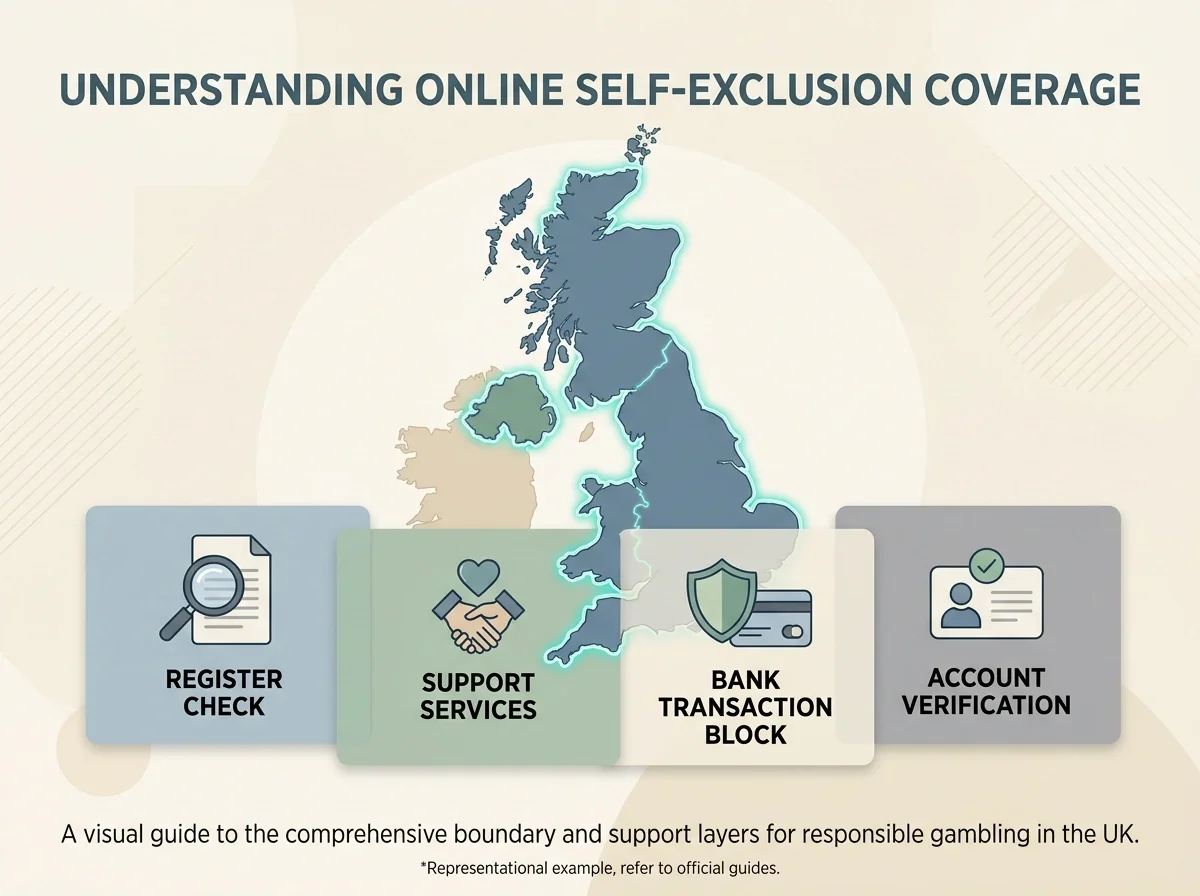
GAMSTOP Parameters: The Core UK Coverage Rules
GAMSTOP covers participating online gambling businesses. In Great Britain, licensed online gambling businesses must take part in the scheme. That is why a site that is genuinely licensed for Great Britain online gambling should sit within this self-exclusion framework. When a website is described as outside GAMSTOP coverage, the next question is not “how do I use it?” but “what does that say about the licence, safeguards and checks?”
For Great Britain consumers, providing gambling facilities without a Gambling Commission operating licence or valid exemption is illegal. An overseas licence does not give the same permission to serve Great Britain consumers. This is why broad claims about international licensing should be treated carefully. They may sound official, but they do not answer the Great Britain licence question on their own.
The safest first move is to check the operator and domain against the Gambling Commission public register. That check belongs on the licence, owner and domain page. This page stays with the self-exclusion boundary: what GAMSTOP is, how it works at a high level, and what to do if you are thinking about gambling despite an exclusion.
Exclusion periods and why early cancellation is not the answer
GAMSTOP registration options include six months, one year, five years, and five years with automatic renewal. A self-exclusion cannot be deactivated until the minimum exclusion period has ended. That rule can feel frustrating if you registered during a stressful moment and later want to gamble again, but the minimum period is part of the protection. It is meant to remove the need to make a new decision every day.
Attempts to get around self-exclusion should not be presented as clever fixes. They can expose you to websites with weaker checks, unclear ownership, payment friction, poor complaint routes and fewer safer-gambling tools. They can also make it harder to keep control if gambling is already causing stress, debt or conflict. A protective tool is not failing because it blocks what it was meant to block.
If the exclusion period is still active and you feel pressure to gamble, the useful question changes. Instead of looking for a route around the restriction, ask which extra layer would help right now: support conversation, bank gambling-payment block, device or website blocking, debt advice, or a practical plan to step away from the screen.
A simple decision path
- Are you currently self-excluded? If yes, treat the urge to find another route as a warning sign rather than a shopping task. Move to support and blocking tools.
- Is the site licensed in Great Britain? If you cannot confirm the licence through the public register, do not rely on an overseas badge or a footer claim.
- Are you trying to undo or avoid a protection? If the answer is yes, pause. The safer response is to strengthen protection, not to search for a weaker site.
- Is money pressure involved? If you are chasing losses, borrowing, using rent or bill money, or hiding gambling from someone close to you, consider help and payment blocks before any account action.
- Do you simply need to understand the rule? Use official pages and the public register. Avoid pages that turn the topic into a list of places to play.
Coverage facts, checks and things not to do
| Situation | What it means | Safer response |
|---|---|---|
| A licensed Great Britain online operator is involved. | Licensed online gambling businesses must participate in GAMSTOP. | Use GAMSTOP status and the public register as part of the basic trust check. |
| A site says it is outside GAMSTOP coverage. | The claim does not prove safety, legality for Great Britain consumers or fair treatment. | Check the licence and domain before you consider any account action. |
| A site promotes looser identity checks or easier access. | Lower barriers may sound convenient but can also be a risk signal, especially around illegal-market engagement. | Do not treat weaker checks as a benefit; read the ID and withdrawal guide. |
| You want to gamble while self-excluded. | That urge may be connected to pressure, stress or loss chasing. | Use support routes, bank blocks and practical interruption steps. |
| You are confused by mixed licence wording. | An overseas licence or vague regulator name does not answer the Great Britain licence question. | Go back to the public register and compare exact names and domains. |
Best casino sites in the UK
- x3betBonus: Welcome Pack 100% Up to £1.000 + 200 Free Spins · Payout speed: 1-3 business days
- BeOnBetBonus: 100% up to €500 + 100 FS · Payout speed: 1-3 business days
- NightWinBonus: £900 + 400 free spins · Payout speed: 1-3 business days
- DieselwinBonus: Welcome Pack 250% up to £4000 + 200 FS · Payout speed: 1-3 business days
- SpinFormulaBonus: 550% Up To £15,000 + 550 FS · Payout speed: 1-3 business days
- AmunbetBonus: Join now and get 450% up to 2,700 GBP + 450 FS · Payout speed: 1-3 business days
Terms to use carefully
Public wording around this topic can easily slide into unsafe shorthand. “Outside GAMSTOP” is clearer than treating the phrase as a benefit. “Not confirmed on the Great Britain public register” is safer than guessing that a site is illegal from one clue. “Check the operator and domain” is more useful than “find alternatives”. “Self-exclusion is active” is more respectful than language that makes protection sound like an inconvenience to defeat.
Careful wording matters because the same reader may be doing several things at once: trying to understand a rule, looking for a place to gamble, feeling frustrated by an exclusion, or worrying about someone else. The right language should make the next safe step easier. It should not make a risky decision feel normal.
Where operator duties fit in
Self-exclusion is a protective tool. Once a self-exclusion agreement is made, gambling businesses have duties such as closing accounts, returning account money and removing the person from marketing databases. Those duties are important because they show that self-exclusion is not just a personal promise. It creates practical obligations for businesses within the relevant framework.
That does not mean every problem is solved automatically. Details still matter: the spelling of your name, date of birth, address changes, account details and how an operator matches information can all affect real-world experiences. The safe response is to keep your details accurate with protective services and use official help when something goes wrong. It is not to use false details or open duplicate accounts.
Support and payment controls
If the reason you are reading about coverage is that you feel pulled toward gambling during an exclusion period, support is not a punishment. It is a practical route to reduce pressure. GamCare lists the National Gambling Helpline, 0808 8020 133, and TalkBanStop information. The Gambling Commission also points the public to organisations that can help with gambling harm, money, debt and crisis support.
Bank gambling-payment blocks are another protective layer. The Gambling Commission provides public guidance on these blocks, and the current details depend on the bank. A bank block does not solve every problem, and it should not be described as a guarantee. It can, however, add friction at the moment when fast access to money would make things worse.
For a practical route, read support options when gambling feels hard to control. For money controls and payment warning signs, read payment and spending controls. If your immediate worry is personal documents or delayed withdrawals, read why ID checks happen.
The safest summary
GAMSTOP coverage is not a narrow technical detail. It is part of the wider Great Britain online gambling protection system. If a site is outside that coverage, you should not treat the difference as a selling point. Check the official licence, look for transparent account information, read terms before depositing, and use support when the topic is connected to stress, self-exclusion or loss chasing.
The practical rule is: coverage questions should lead to official verification and support, not to a list of places to play. If a page or advert turns the issue into excitement, urgency or a promise of easy access, step back and check the basics again.
If you feel that your gaming habits are becoming unmanageable, there are numerous support options for gambling problems available to help you regain control.
Explore safe and verified platforms tailored for UK players on our reputable non-GAMSTOP casinos homepage.
Created by the "Casino not on Gamstop" editorial team.