
UK Gambling Licence Register: Verify Casino Owners and Domains
 Available in GB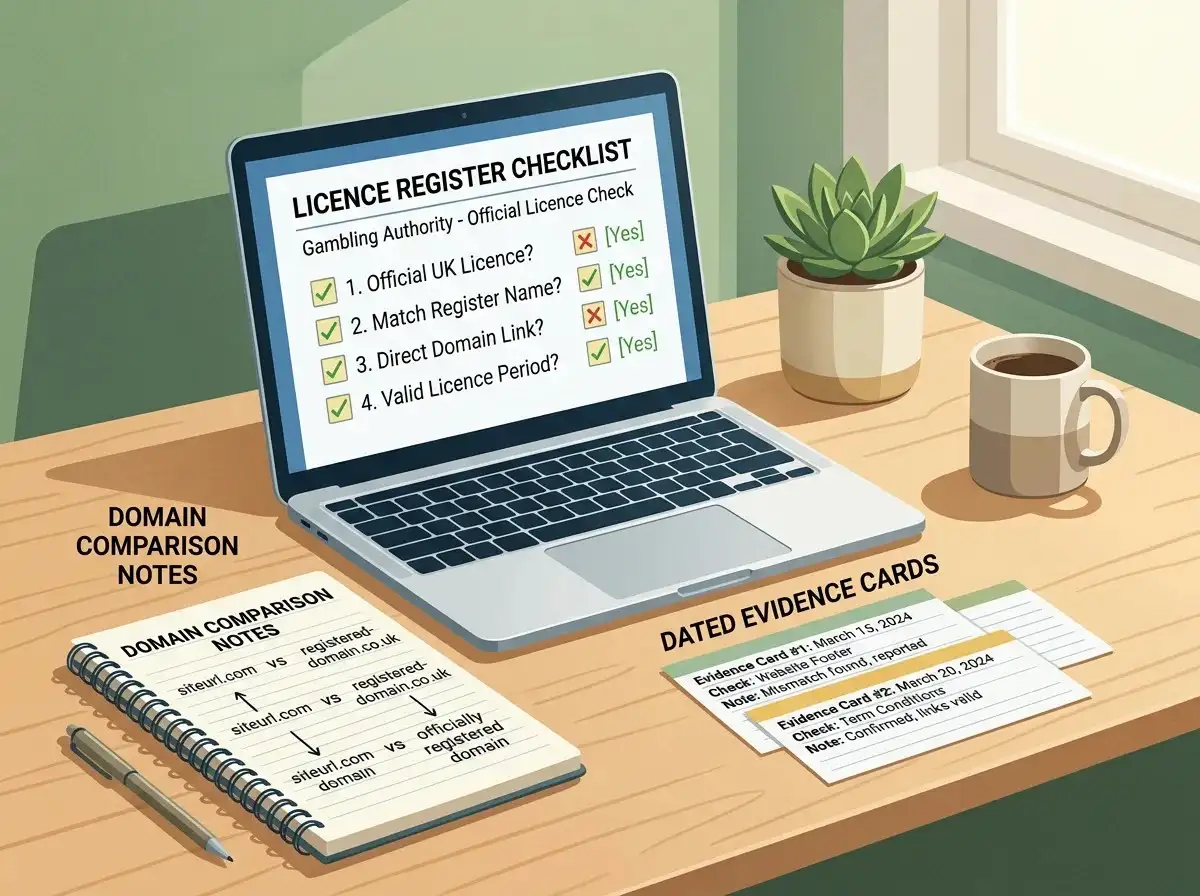
- Licence Checks: The Most Critical Trust Signal
- What to gather before using the public register
- A step-by-step licence, owner and domain check
- Best casino sites in the UK
- Strong evidence, weak evidence and warning signs
- What the check can and cannot prove
- When a mismatch should make you stop
- Next checks after the licence baseline
Licence Checks: The Most Critical Trust Signal
For Great Britain consumers, gambling facilities need a Gambling Commission operating licence or a valid exemption. An overseas licence is not the same thing as permission to offer gambling to Great Britain consumers. That distinction matters because many commercial-looking claims are built around badges, country names, broad wording about international regulation or vague “licensed” language. Those claims may sound reassuring, but they are not enough on their own.
The Gambling Commission public register is the central place to check a gambling business. It can be searched by business name, trading name, domain name or account number. The register can show the licence status and regulatory actions connected with a licensed business. The register also carries its own caveat around domain and trading-name data, so a check should be careful rather than automatic. A single matching word is not the same as a complete match between the site, the owner and the licence record.
Before account opening, a gambling website or app should make key information available. That includes its licensed status, account fees, customer-funds protection, free offers or bonuses, and terms and conditions. If a site makes those items hard to find, mixes company names, hides the licence account number or only gives a broad overseas badge, treat that as a reason to pause. The point is not to prove wrongdoing from one weak signal. The point is to avoid acting on weak evidence.
What to gather before using the public register
Start on the website itself, preferably before creating an account. Open the footer, terms page, about page and any licence or regulatory page. Write down the exact domain in the address bar, including whether it uses a subdomain. Then write down the business name, trading name, licence account number if shown, and any country or regulator named in the footer. If the account-opening flow shows extra licence details, capture those too before depositing any money.
Keep the details literal. Do not simplify a company name, remove initials or assume that a similar-sounding trading name is close enough. A site may show one brand name to players and a different company name in the footer. That can be normal where the register confirms the relationship, but it should not be guessed. The check only works when you compare exact words, exact domains and exact numbers.
It is also worth saving dated screenshots of what you saw. Screenshots are not a formal decision, but they are useful if details later change, if support gives inconsistent explanations, or if you need to prepare a complaint about a licensed operator. Keep the address bar visible where possible, because a screenshot of a footer without the domain is much weaker evidence.
A step-by-step licence, owner and domain check
- Identify the exact website. Copy the visible domain from the address bar. Do not rely on a shortened link, advert, email link or review page.
- Find the operator details on the site. Look for the legal business name, trading name, licence account number, regulator wording, customer-funds wording and terms link.
- Search the Gambling Commission public register. Use the official register search by business name, trading name, domain name and account number. Try more than one field if the first search does not resolve the question.
- Compare the details, not just the brand. Check whether the domain shown on the site appears in the register result, whether the business name matches, and whether the licence status is current.
- Look for regulatory actions or warnings in the register result. A licence record can contain information that affects how much confidence you place in the operator.
- Compare account-opening information. Before registering or depositing, check whether the site gives the information a licensed site should make available, including fees, customer-funds protection, bonus terms and the full terms and conditions.
- Save evidence before acting. Keep screenshots, dates, the domain, the register search terms used and any support messages. This is especially important if the site later changes its wording.
If the register search does not confirm the website, do not treat the gap as a puzzle to solve by trusting the site harder. A missing match, an overseas-only licence claim, a domain mismatch or a hidden owner is a reason to stop and verify through official channels before you send money or documents.
Best casino sites in the UK
- x3betBonus: Welcome Pack 100% Up to £1.000 + 200 Free Spins · Payout speed: 1-3 business days
- BeOnBetBonus: 100% up to €500 + 100 FS · Payout speed: 1-3 business days
- NightWinBonus: £900 + 400 free spins · Payout speed: 1-3 business days
- DieselwinBonus: Welcome Pack 250% up to £4000 + 200 FS · Payout speed: 1-3 business days
- SpinFormulaBonus: 550% Up To £15,000 + 550 FS · Payout speed: 1-3 business days
- AmunbetBonus: Join now and get 450% up to 2,700 GBP + 450 FS · Payout speed: 1-3 business days
Strong evidence, weak evidence and warning signs
| What you see | How to treat it | Safer next step |
|---|---|---|
| The exact business name, trading name, domain and licence account number line up in the official public register. | This is strong baseline evidence for the identity check, though it is not a recommendation or a guarantee of a good experience. | Continue with terms, funds, ID and payment checks before depositing. |
| The footer says “licensed” but does not make the Great Britain licence status easy to verify. | This is weak evidence because it asks you to trust a claim without enough official confirmation. | Search the register using the exact names and domain, and stop if the match remains unclear. |
| The site only names an overseas regulator or a broad international licence. | For a Great Britain consumer, overseas wording is not a substitute for a Gambling Commission operating licence or valid exemption. | Do not treat the overseas licence as enough for Great Britain access. |
| The site promises low identity barriers, unusual payment routes or fast withdrawals without clear terms. | Those claims may look convenient, but they overlap with risk signals seen around illegal-market engagement. | Check the licence first, then read ID, payment and withdrawal terms carefully. |
| Names, domains or account numbers do not match across the site and the register. | This is a warning sign. It may be an error, a stale footer or something more serious, but it should not be ignored. | Pause, save evidence and do not deposit until the mismatch is resolved through official information. |
What the check can and cannot prove
A licence and domain check can show whether the basic identity story is coherent. It can help you avoid trusting a badge without confirmation. It can also show whether the site’s visible details are complete enough to inspect. What it cannot do is prove that a named operator will pay quickly, that every term is fair in your situation, that a future support answer will be accurate, or that a site outside Great Britain oversight is safe to use.
The Gambling Commission explains how online gambling games are tested and monitored for fairness in the licensed market. That does not verify every unlicensed or unconfirmed website. Be careful with any public claim that a site is “fair”, “safe”, “verified” or “trusted” unless the claim is tied to current official evidence and the exact domain you are checking.
The same caution applies to reviews and affiliate-style lists. They may describe user experiences, but they do not replace the public register. A review can be out of date, promotional, based on a different domain, or written without checking the licence account. Use it, at most, as a prompt to ask better questions, not as proof.
When a mismatch should make you stop
Some mismatches are small enough to ask about; others are serious enough to stop immediately. A spelling variation in a trading name may need checking. A domain that does not appear where you expect, a company name that leads nowhere, a licence claim that cannot be found, or a support team that refuses to identify the licensed business should be treated as a stronger warning.
Do not send documents simply because support says the issue will be clarified later. If you are asked for identity documents, payment evidence or personal information before the licence story is clear, consider the data risk as well as the gambling risk. A legitimate identity check is one thing; sending sensitive information to a site whose owner cannot be verified is another.
If you are looking at the site because you are self-excluded or trying to gamble during a period when you meant to stop, the missing or mismatched licence details are not a technical obstacle to get around. They are a sign to pause and use support. You can read more about how GAMSTOP coverage works and about support options if the search for another site is connected to stress, loss chasing or pressure to deposit.
Next checks after the licence baseline
Once the identity and licence baseline is clear, move to the account terms. Read the parts that explain fees, customer-funds protection, bonus restrictions, withdrawal rules and what happens to your own deposit balance. A site can pass the basic identity check and still have terms that are uncomfortable for you. That is why the licence check should be the first screen, not the last decision.
Then consider the account-use checks. Licensed online gambling businesses must ask users to prove age and identity before gambling. A claim that avoids verification altogether should not be treated as a benefit. If you are mainly worried about delayed withdrawals, read the guide to ID checks, personal data and withdrawal problems. If you are mainly comparing terms around bonuses or account money, read the guide to bonus and customer-funds wording.
Once you have verified the operator’s credentials, it is equally important to understand how online gambling ID checks and withdrawals are processed to avoid unexpected delays.
For a comprehensive overview of trusted platforms, return to our main guide on casinos outside GAMSTOP coverage.
Created by the "Casino not on Gamstop" editorial team.